The Germania Building · Cincinnati

A place can have more than one life.

At Walnut and Twelfth since 1877. The people, rooms and changing names behind the building that became The Muse.

Follow the story
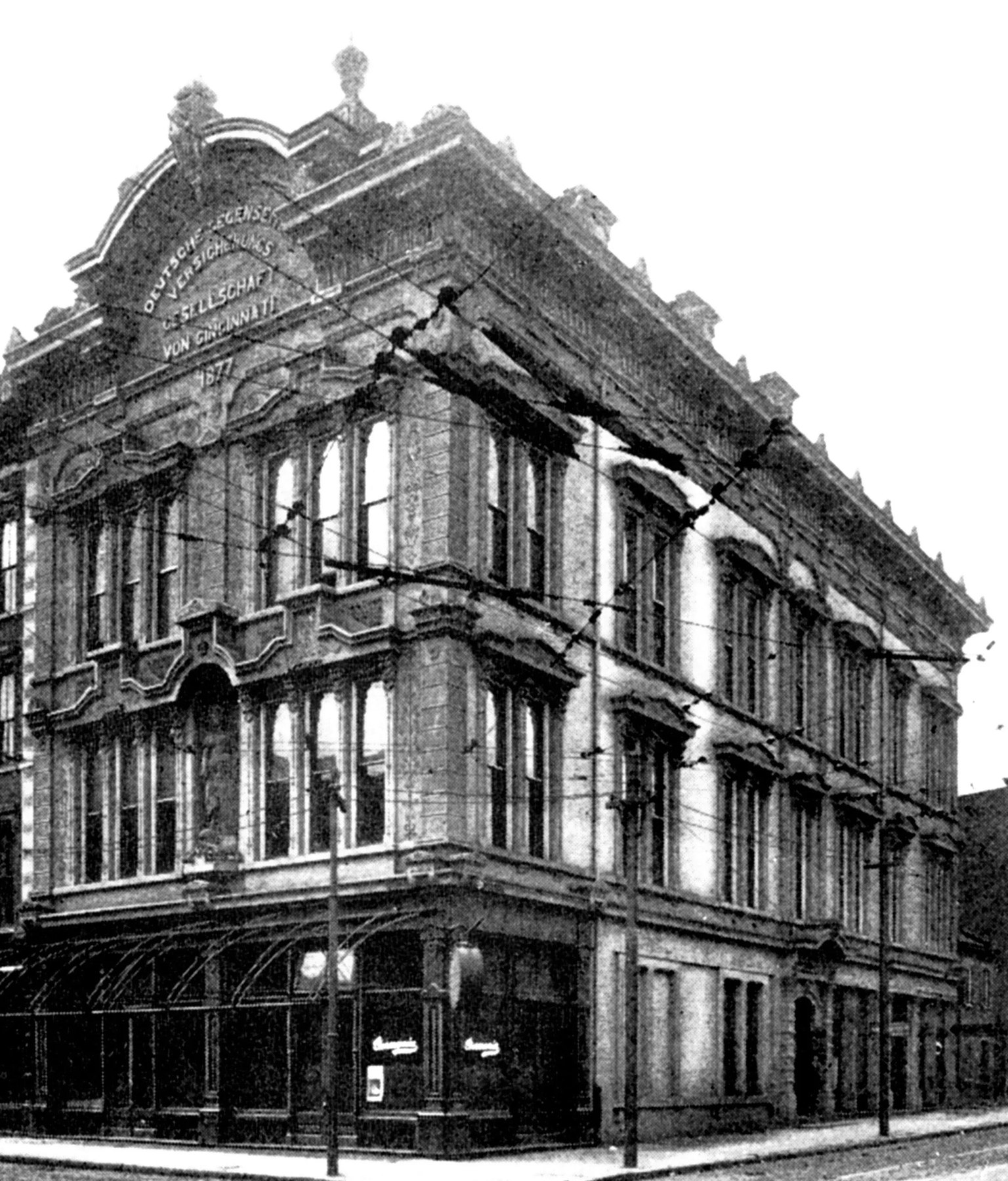
The Germania Building photographed in 1901
Walnut & Twelfth, 1901. From Cincinnati, the Queen City.
011832–1923

The man behind the company.

Heinrich A. Rattermann was born in Ankum in 1832 and came to Cincinnati at fourteen. He worked in the lumber trade before helping to establish the insurance company that would build Germania.

Insurance was only part of his life. He became a historian, poet and editor, helped establish literary and musical associations, and published hundreds of poems. German-American history became his lifelong work.

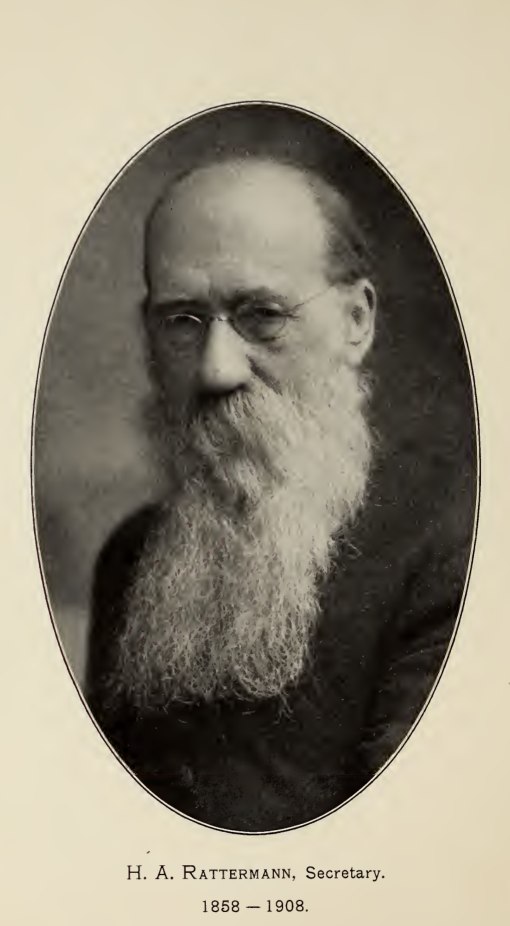
Portrait of Heinrich A. Rattermann with his long beard
01.1 H. A. Rattermann, secretary. Portrait in the 1908 anniversary book, PDF p. 4.
021856

A fire. Then an idea.

In the spring of 1856, a fire at Walnut and Thirteenth destroyed about a dozen buildings. When the owners went to claim their insurance, they found their insurer had failed.

Rattermann knew the problem at close quarters. On 15 August 1856, he met Henry Mueller, H. H. Kuhlmann and Benjamin Heuer to discuss an insurance company of their own.

The account of the fire and first meeting comes from Rattermann’s recollection, published fifty years later.

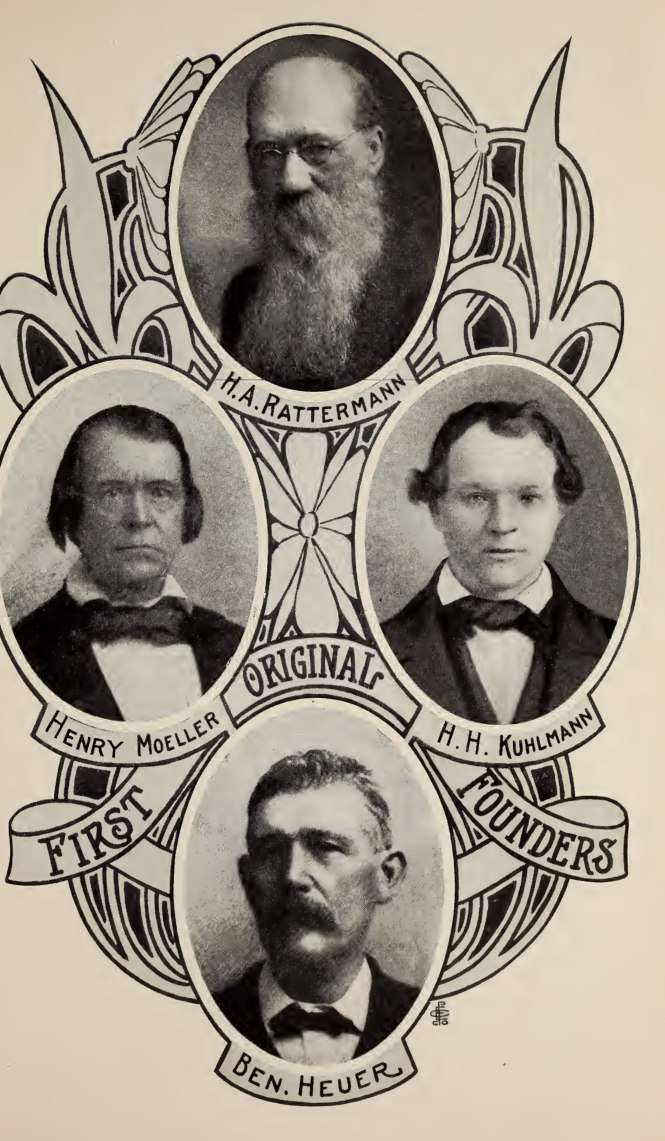
Four founders of German Mutual in a decorative portrait montage
02.1 The four founders, reproduced in the company’s 1908 anniversary book, PDF p. 11.
031858

Two rooms on Vine Street.

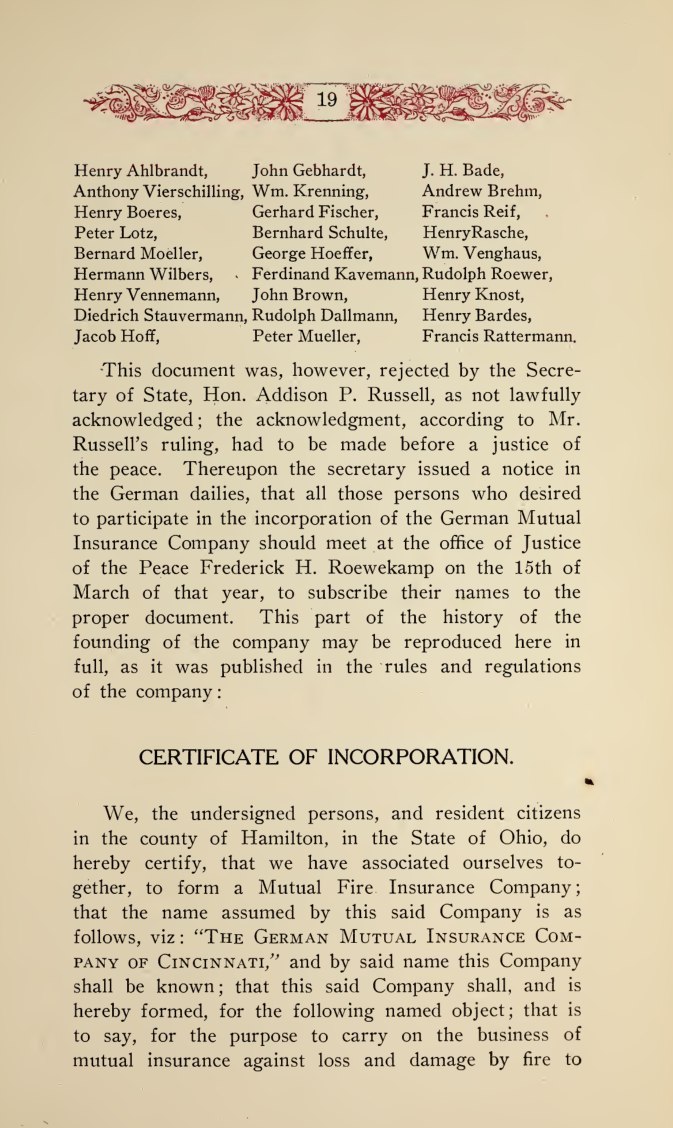
After Ohio passed its mutual-insurance act on 14 April 1857, the founders could put their plan into practice. The incorporation papers were signed on 15 March 1858; the state certification followed on 18 March.

German Mutual opened for business on 10 May. Its first office was two rooms in National Hall, at the old address 400 Vine Street, rented for ten dollars a month. Before coming to this corner, the company also worked from Walnut and Thirteenth.

Incorporation certificate reproduced in the 1908 company history
03.1 The company’s incorporation documents, reproduced in 1908. PDF p. 75.
041867–1877

A permanent home.

A modest office-building proposal was voted down in 1867. Ten years later, the board went ahead with a more ambitious home at Walnut and Twelfth. A May 1877 deed report records a property sale from Miles Greenwood and his wife to German Mutual.

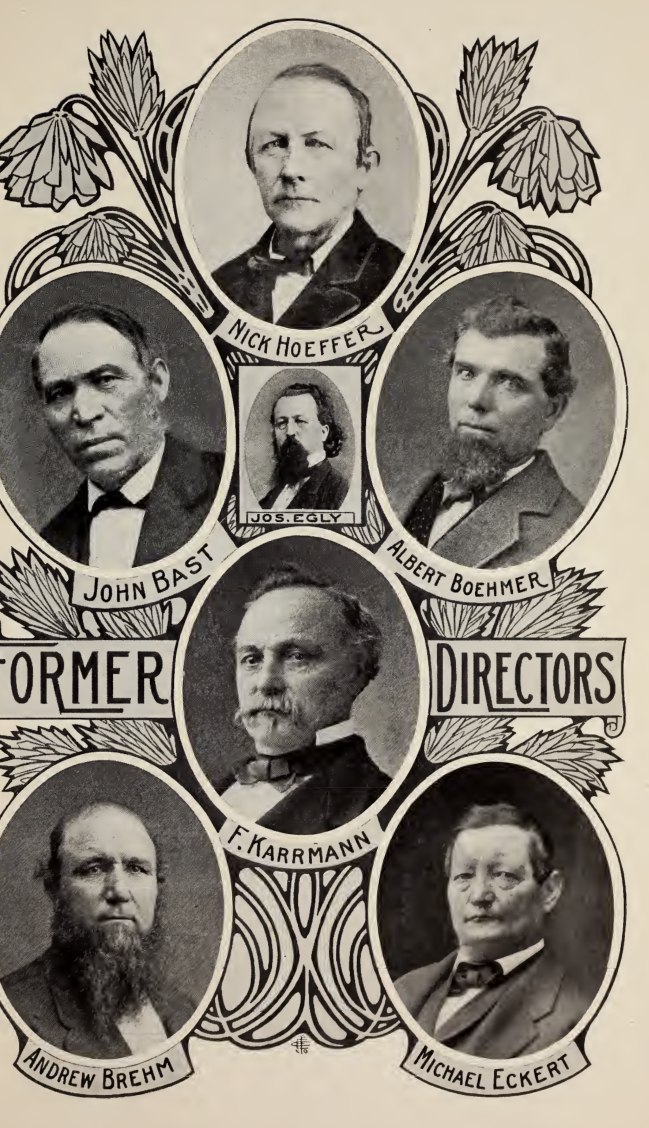
Architect Johann Bast designed the Germania Building in the Renaissance Revival style. Schreiber and Sons supplied the cast-iron storefront and ornate cornice. The building was completed in 1877, with a stone façade cut into panels, brackets and elaborate ornament.

1877 is the construction year. The exact opening day has not been established; a later newspaper account dates the company’s occupancy from 1878.

Historic view of the Germania Building at Walnut and Twelfth, before the additional full-height storey
04.1 The Germania Building in Cincinnati, the Queen City, George W. Engelhardt Co., 1901.
Portrait montage of former company directors, including John Bast at upper left
04.2 Johann Bast appears as John Bast, upper left, among the former directors in the 1908 book. PDF p. 81.
051877

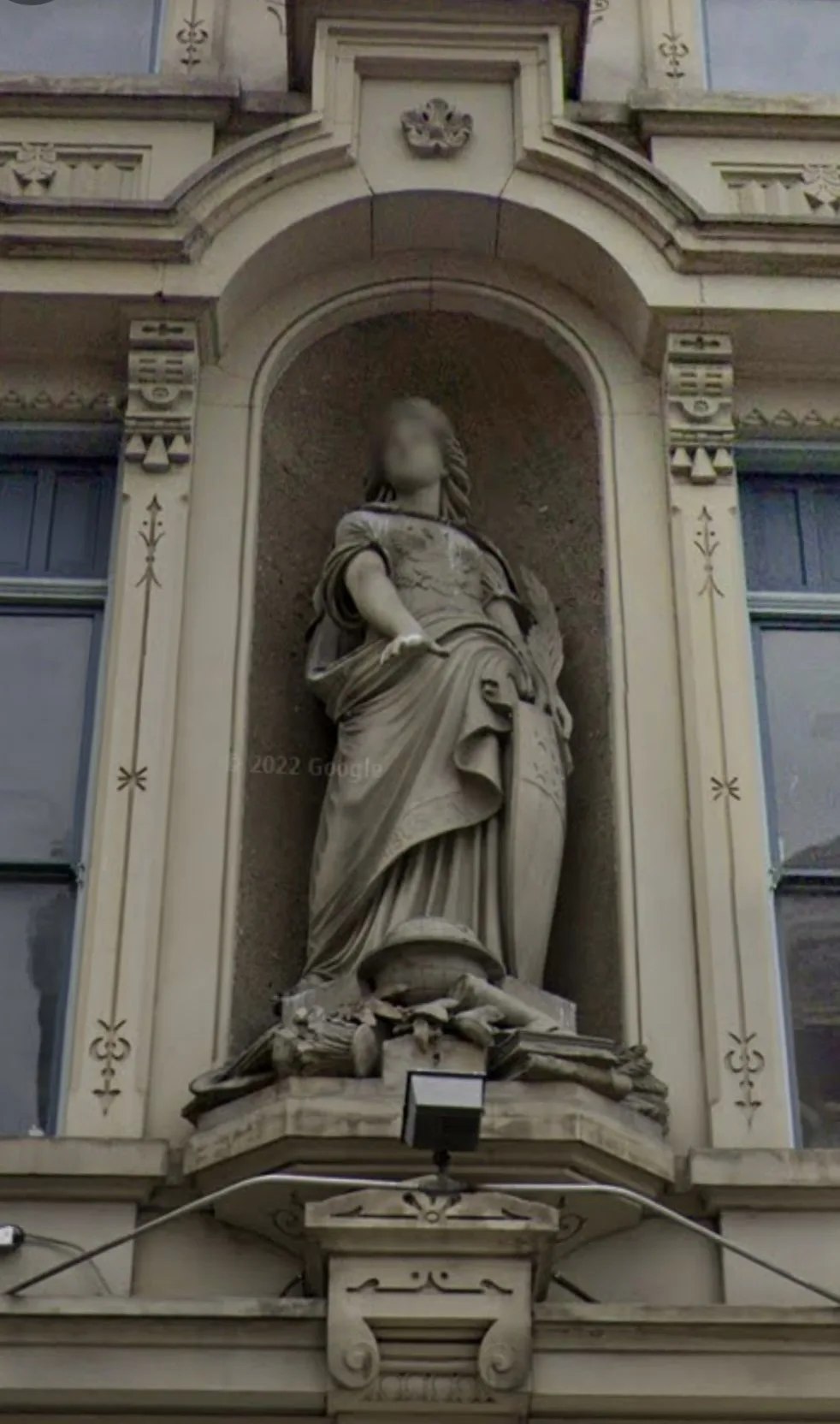
Germania, above the street.

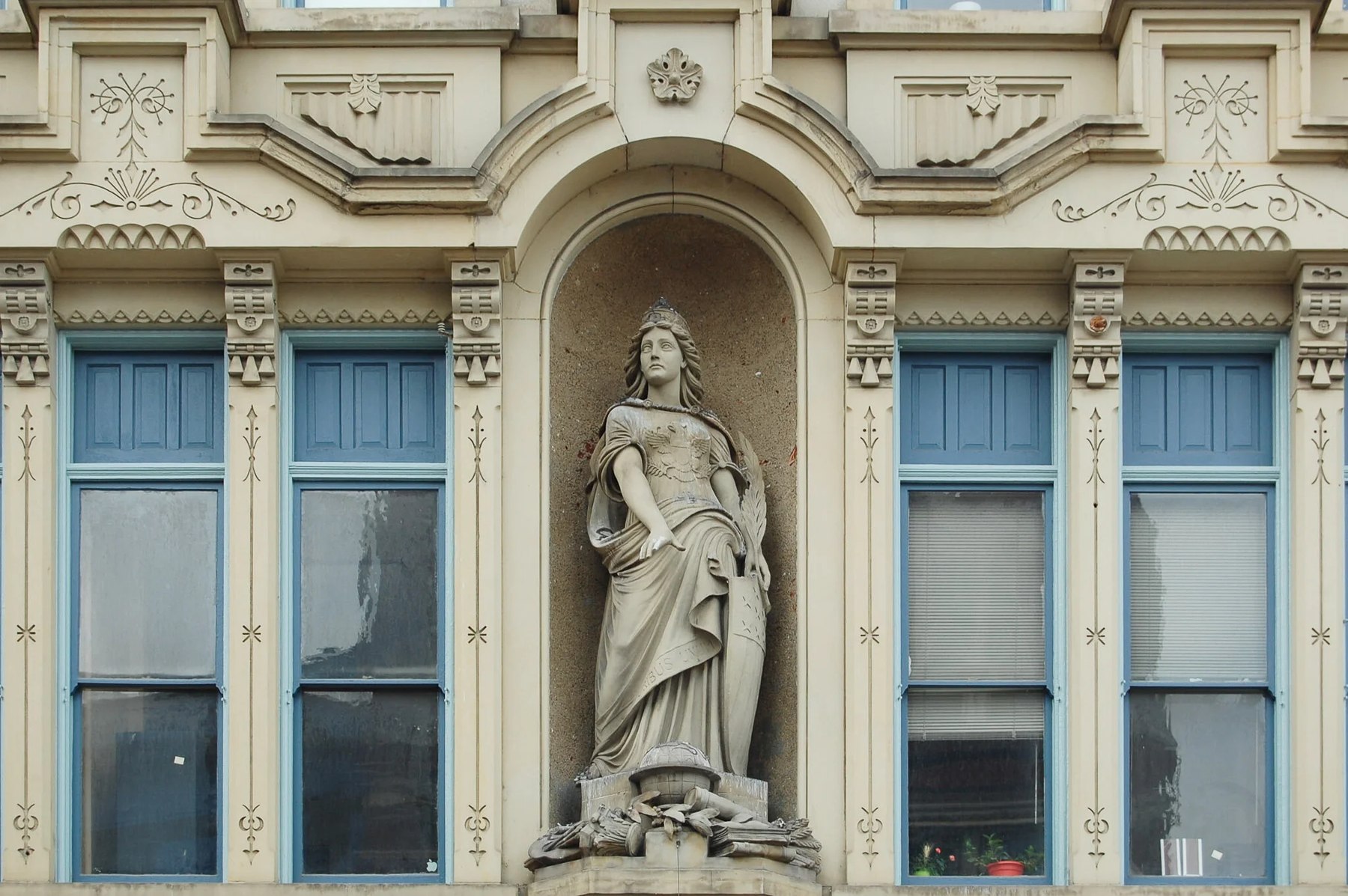
Leopold Fettweis carved the figure on the Walnut Street façade. Germania represented German culture and spirit; the globe, books and painter’s palette at her feet referred to art, learning, astronomy, architecture and nature.

Around the corner, above the Twelfth Street entrance, Fettweis placed Apollo driving four horses. The god of music and poetry would remain part of the insurance company’s identity long after its name changed.

Fettweis (1848–1912) was born in Cincinnati, studied in Rome and taught clay modelling at the Ohio Mechanics Institute. The statue shown here includes later alterations.

The Germania statue in its arched niche above Walnut Street
05.1 Germania on the Walnut Street façade.
06Every week

Orpheus rehearsed here.

German Mutual offered space in the building for the weekly rehearsals of Cincinnati Orpheus, a musical association of about a hundred members.

The building history records the weekly meetings on p. 6, without giving their start or end dates.

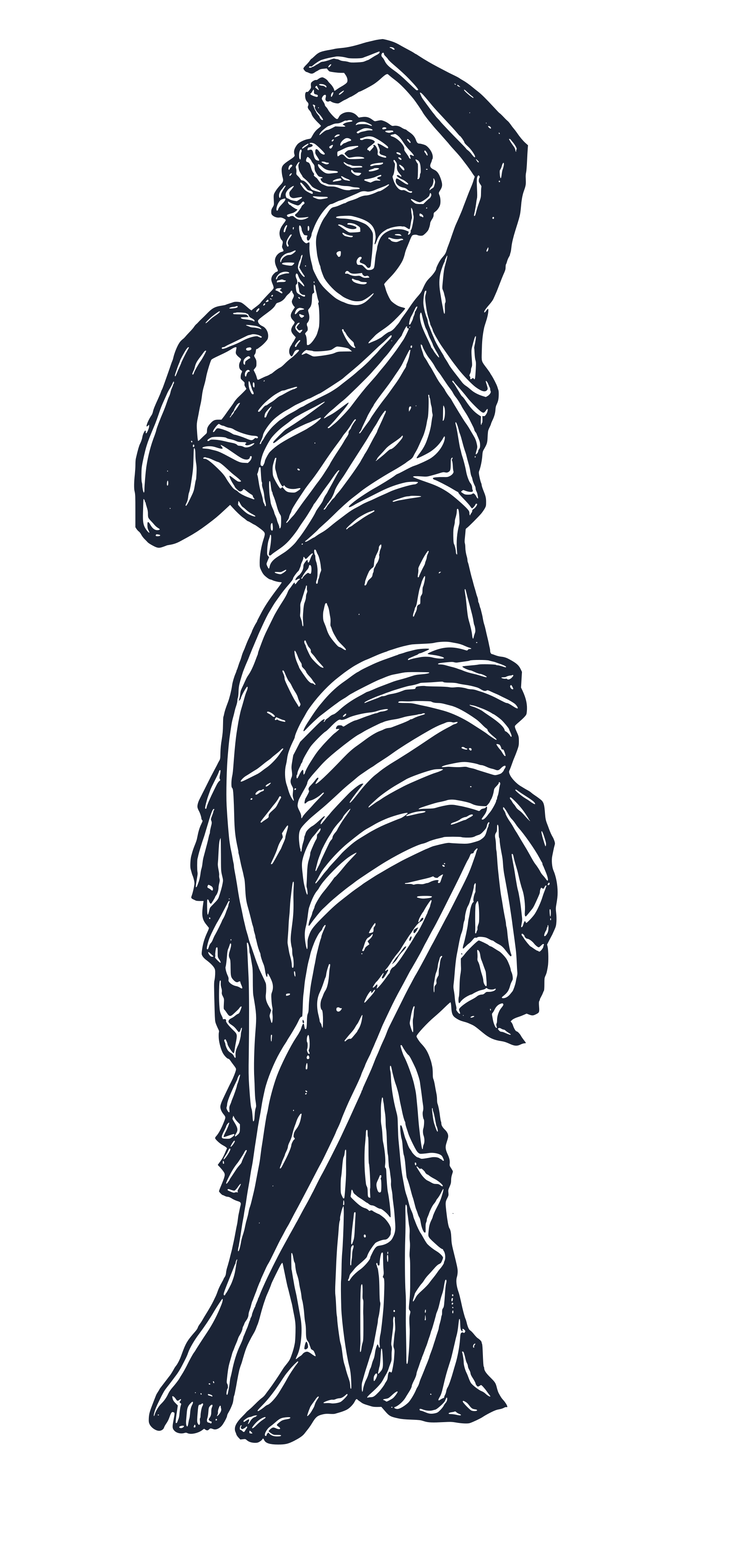
A dancing Muse lifting a lyre, from the Muse’s Terpsichore illustration
071883

The corner, in motion.

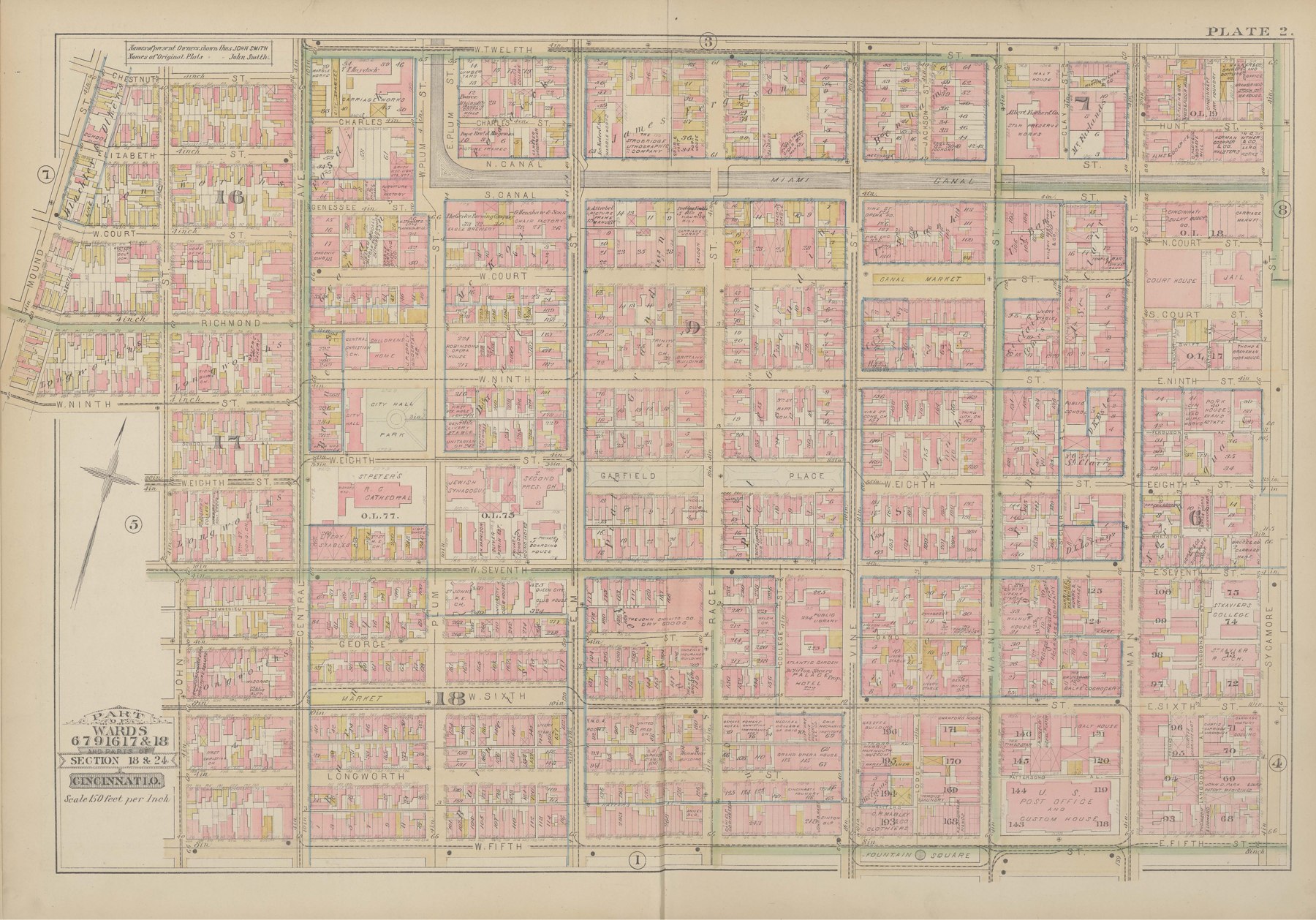
The 1883 city atlas places the building at 411 Walnut Street, its address before the city’s renumbering. Horse-drawn railway lines ran past on both Walnut and Twelfth.

This was a commercial centre within Over-the-Rhine, among shops, meeting halls, beer gardens and places of music.

1883 atlas of the streets around Walnut and Twelfth in Cincinnati
07.1 Atlas of the City of Cincinnati, Robinson & Pidgeon, 1883–84, plate 2.
081908

Inside the insurance rooms.

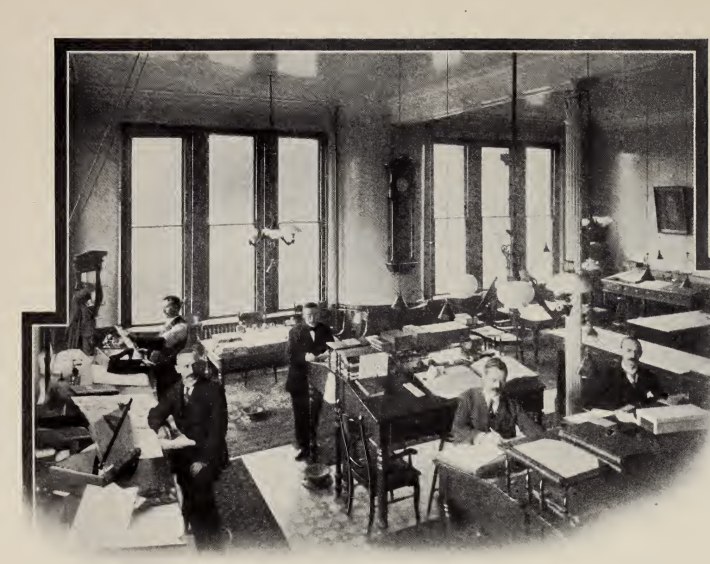
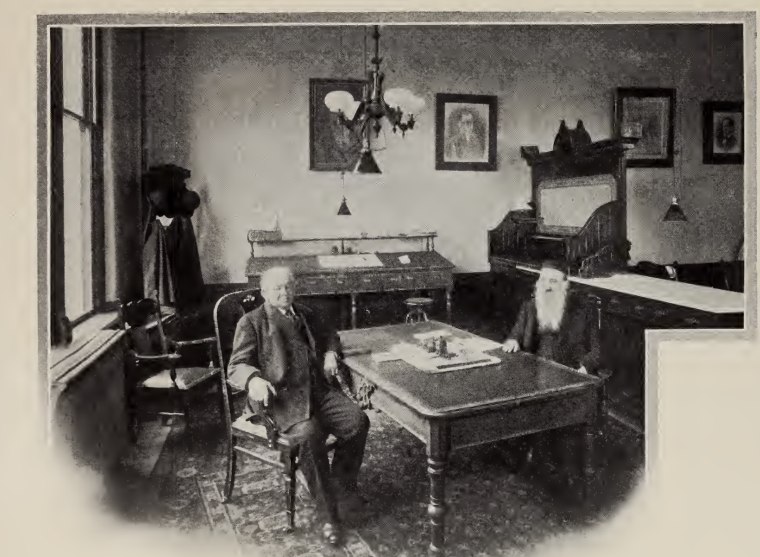
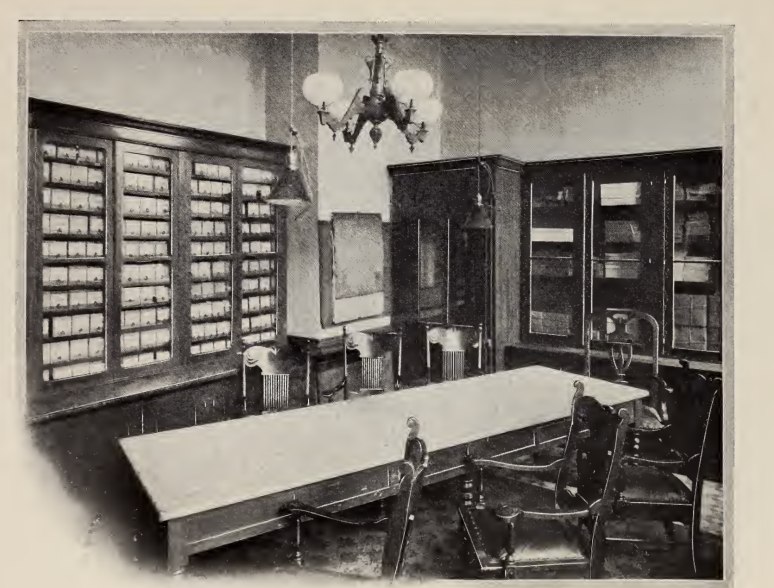
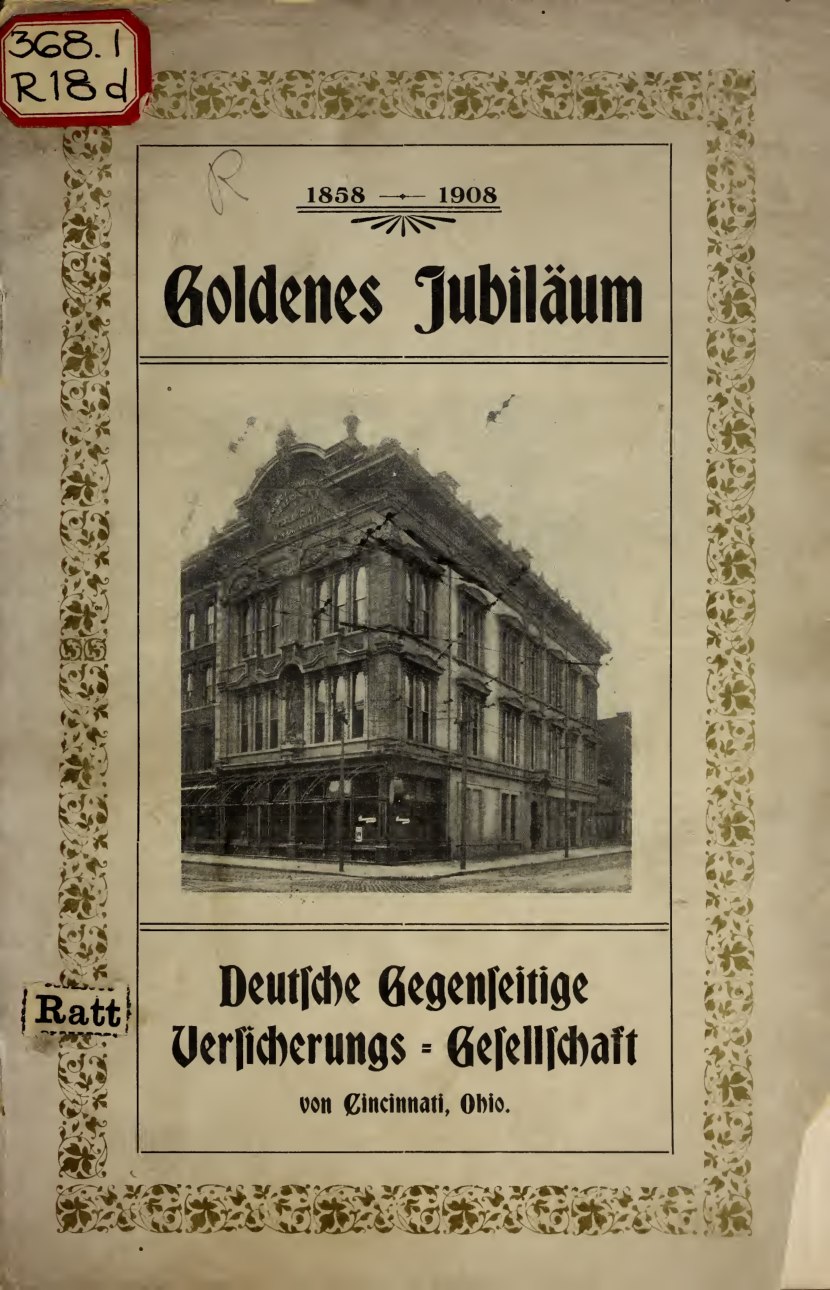
For its fiftieth anniversary, the company published a history in German and English. Between the accounts and certificates are photographs of the people at work: desks by the windows, a president’s office, and a long table in the directors’ room.

These are the rooms before a century of later partitions and renovations. Company records and minutes were kept in German until the First World War.

People working at desks in the tall-windowed main office in 1908
08.1 Main office. Anniversary book, PDF p. 27.
The furnished president’s office photographed for the 1908 book
08.2 President’s office. Anniversary book, PDF p. 57.
Long meeting table and cabinets in the directors’ room
08.3 Directors’ room. Anniversary book, PDF p. 73.
Decorative cover of the company’s 1858–1908 Golden Jubilee book
08.4 The 1908 Golden Jubilee book, with the building on its cover. PDF p. 1.
091908–1957

One floor higher.

At some point between the anniversary photographs and the 1957 sale, the building acquired a full-height fourth storey. Its cast-iron cornice was removed and set back above the addition.

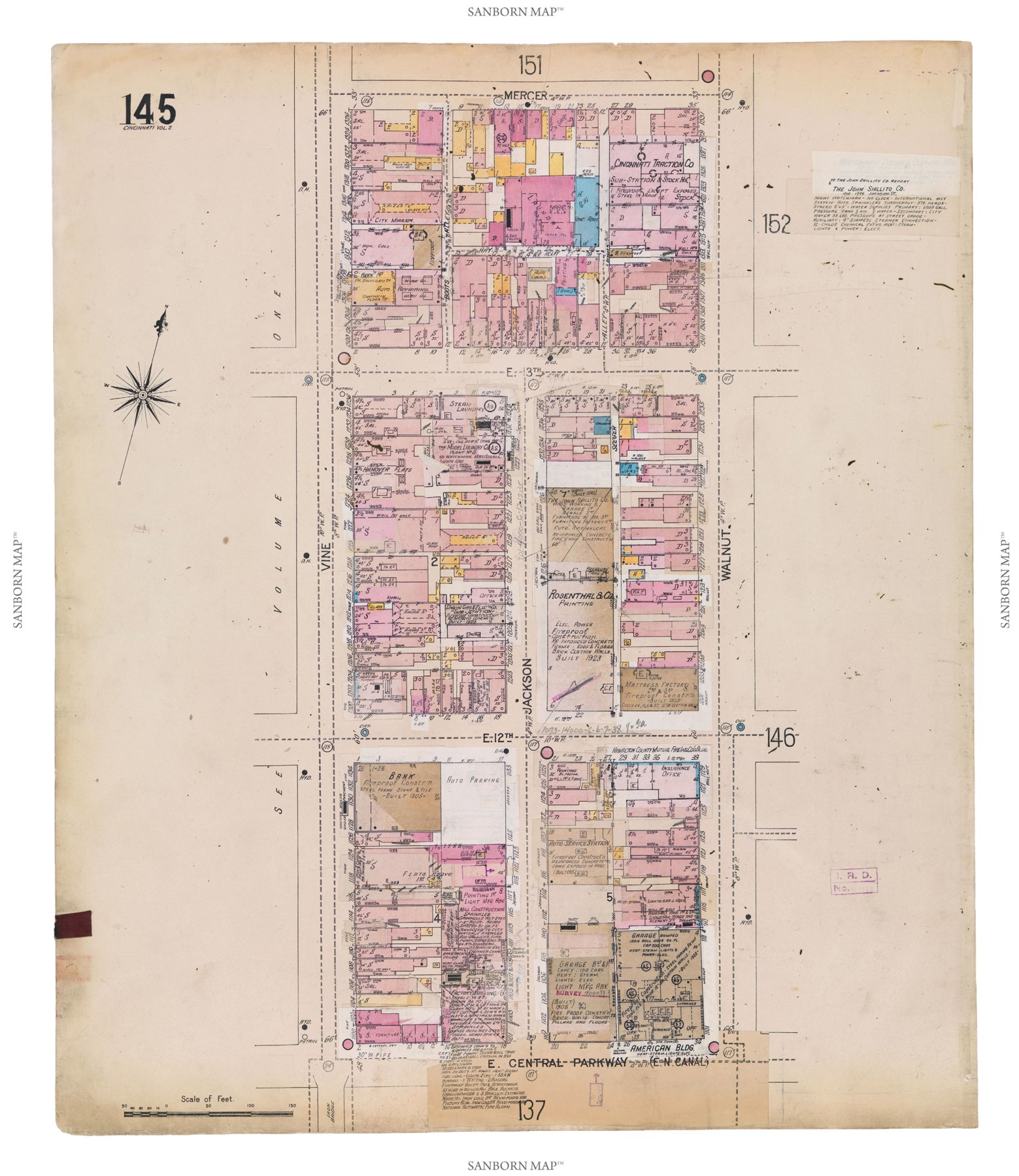
The building continued to accommodate more than insurance. The Sanborn survey, dated 1904 and updated through 1930, records the insurance office in the eastern half of the ground floor and three stores to the west.

The supplied research does not establish the addition’s exact year. The map is a record of use over its stated survey period, not a precise construction date.

Sanborn insurance map plate 145 showing the block around the Germania Building
09.1 Sanborn Insurance Maps of Cincinnati, vol. 2, plate 145. Dated 1904; updated through 1930.
101910s–1930s

A name covered over.

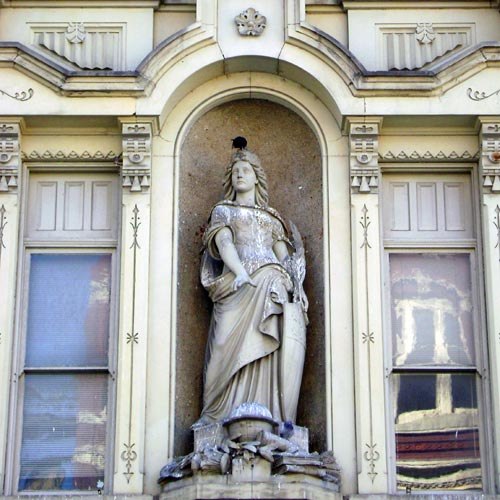
During the First World War and its aftermath, anti-German sentiment changed the building’s public face. The German company name in the cornice was concealed. Germania was covered with a black sheet.

Later, the statue was reworked as Columbia, also described as Liberty: an eagle on her breastplate, flag motifs on her shield, and E Pluribus Unum on her gown. German Mutual became Hamilton Mutual. A 1937 newspaper account looked back on the covering and the statue’s transformation.

These were separate changes. The available sources do not support assigning all of them to a single year, or treating 1917 as a confirmed date for each.

Detail of the Germania statue with the later eagle and shield alterations
10.1 Germania with the later eagle and shield.
111925–1932

Tailoring, shops and offices.

The insurance company occupied only part of the building. Advertisements in 1925 place Lyon Tailoring Co. at 1127 Walnut Street; employment advertisements continue in 1932.

The maps and newspapers record a working commercial building, with shops at street level and offices above. They preserve some of its occupants, though not a complete tenant list.

121957

The insurance company leaves.

Apollo’s chariot still appeared in Hamilton Mutual’s newspaper advertisement on 7 January 1957. That spring, policyholders approved a merger with Druggists Mutual. The company moved to new premises at Madison Road and Victory Parkway in Walnut Hills.

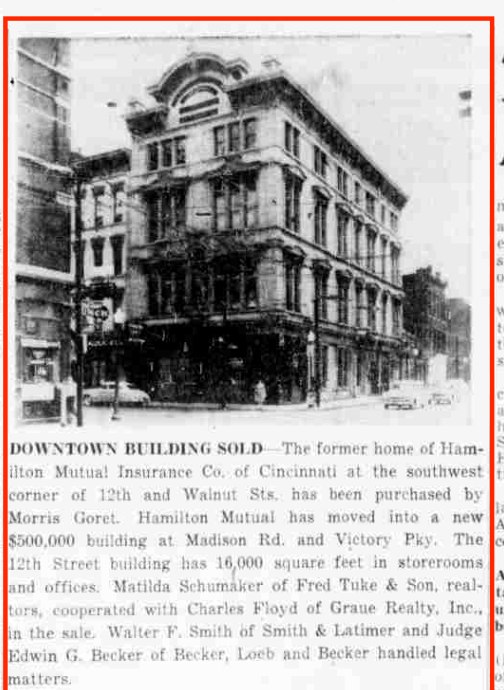
On 14 July, the Enquirer reported that Morris Goret had bought the old building. The sale article described 16,000 square feet of storerooms and offices. Eight decades of insurance-company occupation were over.

The advertisement proves the chariot was used as late as January 1957; it does not establish its final use as a logo.

Hamilton Mutual newspaper advertisement featuring a small Apollo chariot emblem
12.1 Hamilton Mutual advertisement, Cincinnati Enquirer, 7 January 1957, p. 28.
Downtown Building Sold newspaper clipping with a photograph of Germania
12.2 “Downtown Building Sold,” Cincinnati Enquirer, 14 July 1957, p. 89.
131982–1995

Betty Jo Orr.

The building’s historical plaque names Betty Jo Orr as its owner from 1982 to 1995. It credits her vision and determination in helping revitalise both the Germania Building and the surrounding Over-the-Rhine neighbourhood.

The sources assembled here do not supply a continuous ownership history for 1957–1982 or 1995–2020.

142014

The German name returns.

In July 2014, the panels across the cornice were removed. The German company name, hidden since the era of the First World War, could be read again.

The building retained both parts of its history: its recovered inscription and the later changes made to Germania herself.

Photograph of the carved windows and Germania statue in October 2014
14.1 The Walnut Street façade, October 2014.
152020–2026

Back to the bones.

The group behind The Muse acquired the building in March 2020. The first walk-through found tall windows, sixteen-foot ceilings and decades of drywall. Later partitions and finishes came out, revealing the original structure.

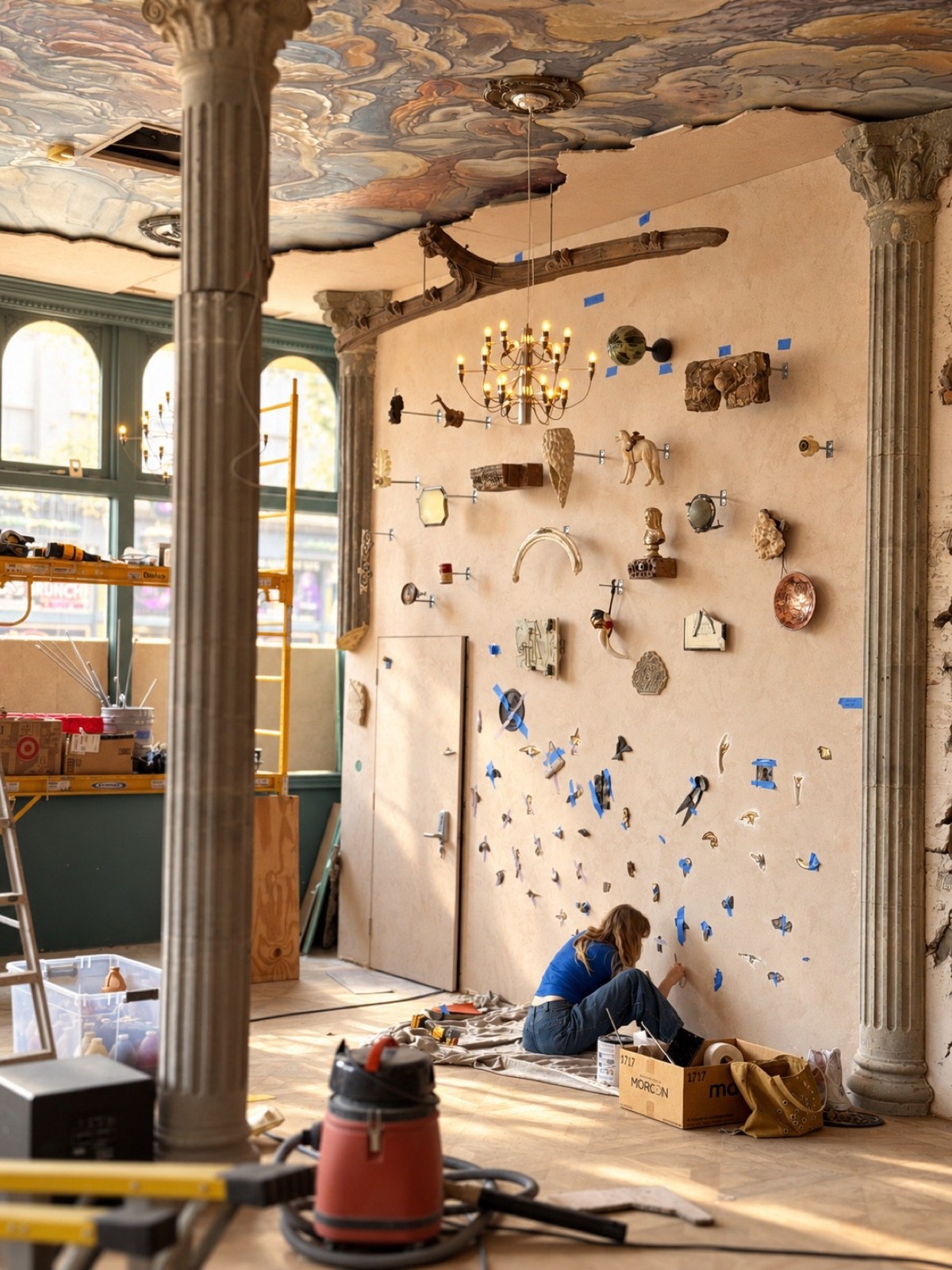
The façade remains original. Inside, the rooms have been made anew. Alex Frank painted the ceiling over nearly a year. A granite slab that broke during the build became the back bar. Custom parquet carries brass stars arranged as the night sky above the building at midnight on 1 January 1877.

1 January was chosen for the floor’s sky; it is not a claim about the building’s opening day. The work included a pause of nearly two years before resuming.

Work underway on the sculptural wall beneath the painted ceiling
15.1 The Muse in the final weeks of the build.
16Now

Another life, at the same corner.

The name The Muse grew from Germania and from the building itself. After spending years here, the people making the bar realised they had fallen in love with the place.

The plan begins with the cocktail bar, followed by a delicatessen and twenty-eight hotel rooms upstairs. A building once devoted to insuring people’s homes is being made into a place to spend an evening, and eventually the night.

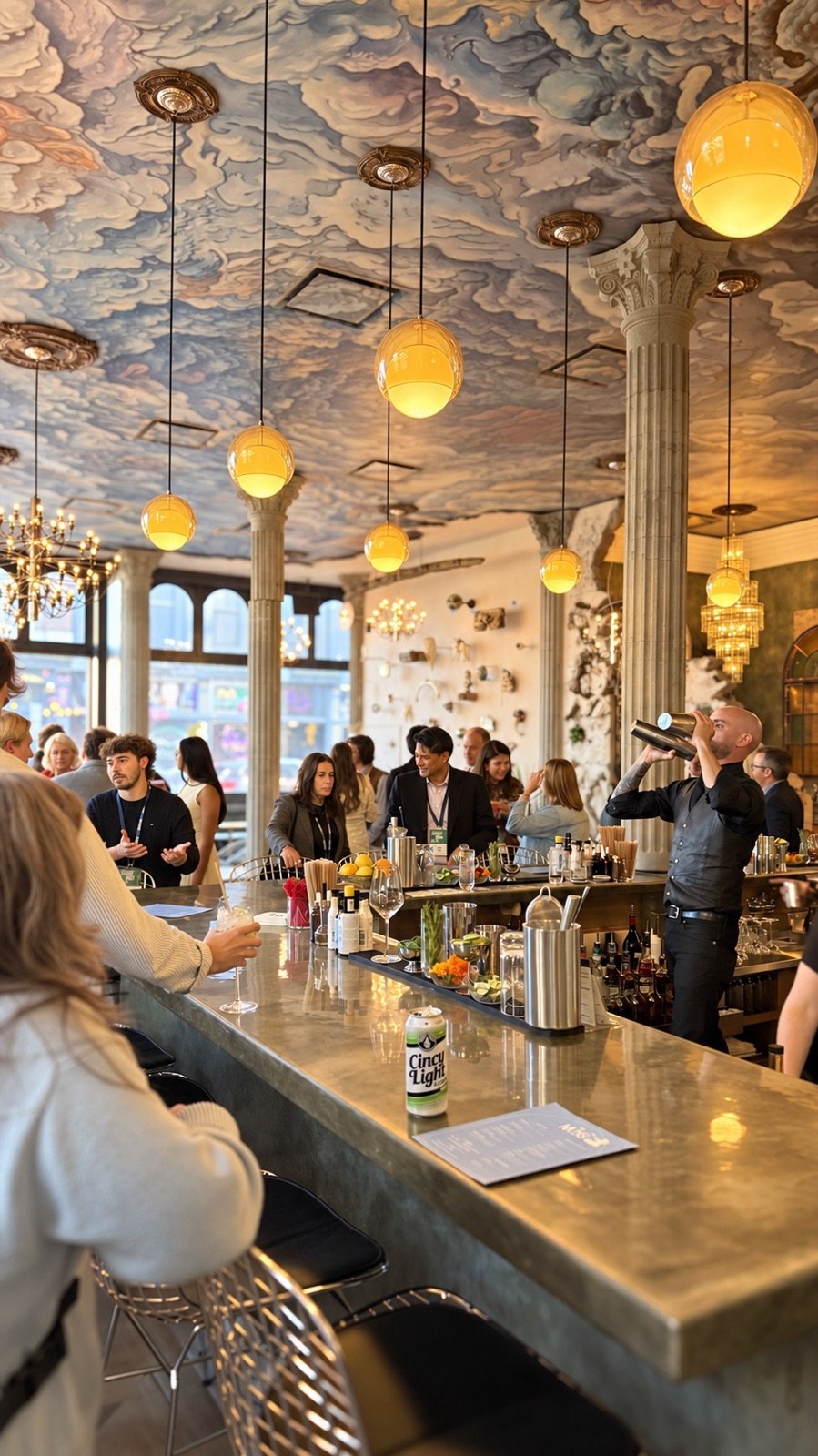
Guests at the Muse bar under its painted ceiling
16.1 A first evening with the lights on.

Sources

From the archive.

Books, maps, newspapers and research on the Germania Building.

  1. Germania Building: Building History

    Common Bond Consulting, 2020. Architecture and sculpture pp. 2–4; Rattermann pp. 4–5; company and cultural life pp. 5–7; wartime changes and later alterations pp. 7–9; maps and transit pp. 9–11. Commissioned research held in the Muse archive; the private report is not reproduced here.

  2. German Mutual’s fiftieth-anniversary history

    H. A. Rattermann, Cincinnati, 1908. PDF pp. 66–70: origins and legislation; pp. 75–80: incorporation and opening; p. 84: the 1867 proposal and 1877 building. Image page numbers appear in each caption. Original historical material, from the saved book scan.

  3. Real Estate Transfers

    Cincinnati Enquirer, 16 May 1877, p. 6. Miles Greenwood and wife to German Mutual. Saved newspaper scan.

  4. The city in maps

    Robinson & Pidgeon, Atlas of the City of Cincinnati, 1883–84, plate 2; Sanborn Insurance Maps of Cincinnati, vol. 2, plate 145, 1904, updated through 1930. Original map scans held in the Muse archive.

  5. A Spot in Cincinnati

    Cincinnati Enquirer, 29 August 1937, p. 6. Retrospective account of Germania’s wartime covering and alteration as Liberty. Saved newspaper scan.

  6. The building’s commercial tenants

    Cincinnati Enquirer advertisements: 6 September 1925, p. 33; 19 December 1925, p. 22; 5 May 1932, p. 24. Saved newspaper scans, read alongside the 2020 building report.

  7. Heinrich A. Rattermann Collection

    University of Illinois Library, Illinois History and Lincoln Collections. Finding aid for Rattermann’s papers; biographical context for his historical, literary and editorial work.

  8. Hamilton Mutual and the 1957 sale

    Cincinnati Enquirer: advertisement, 7 January 1957, p. 28; merger report, 8 May 1957, p. 43; “Downtown Building Sold,” 14 July 1957, p. 89. The sale scan names Morris Goret. Its masthead confirms 1957, correcting the 1958 date in the research bibliography.

  9. The Germania Building historical marker

    Plaque photographed by Craig Doda on 25 June 2022; recorded by the Historical Marker Database. Supports Betty Jo Orr’s ownership dates and the plaque’s dedication to her contribution.

  10. The Muse’s acquisition and hotel plans

    Liz Engel, Cincinnati Business Courier, 10 July 2023. Saved interview records the March 2020 acquisition and a twenty-eight-room hotel plan. Earlier forecasts in that article are not current opening commitments.

  11. The Muse project record

    Muse project notes and photographs, 2026. Restoration, design details, naming and planned phases. Earlier façade photographs are from the Muse history archive; photographers are unrecorded.

A slowly written love letter.

Visit The Muse